The World of Microplastic

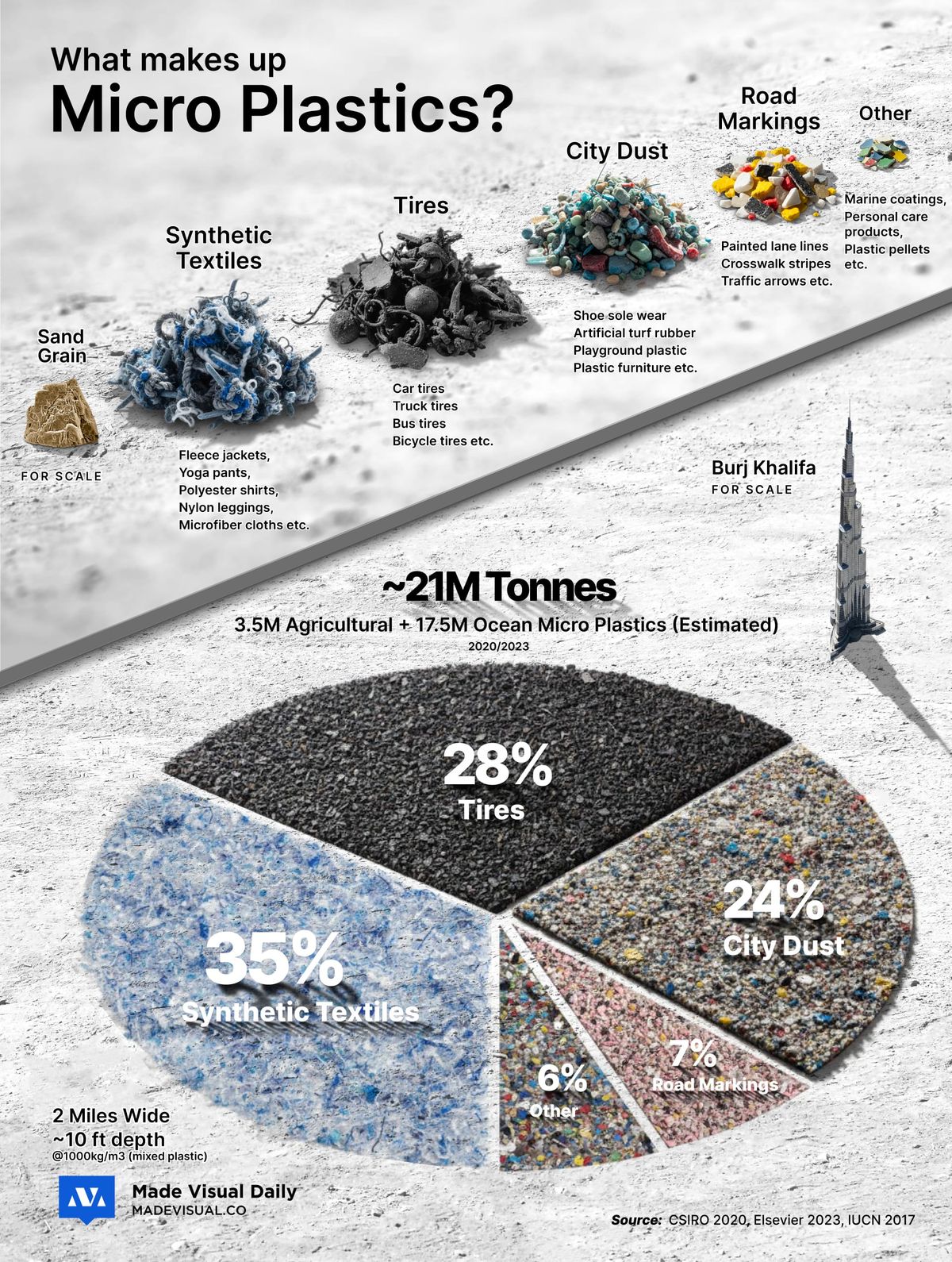
Microplastics—an almost invisible class of plastic fragments smaller than a grain of rice—have become one of the planet’s largest unseen pollutants, accumulating across soils, seas, and even inside the human body.
1. Most microplastics don’t come from bottles or bags.
The vast majority are shed from everyday materials — synthetic clothing fibers, tire wear, and urban dust — not from visible litter.
2. They’re already everywhere.
Scientists estimate roughly 7 million tonnes of microplastics now sit across oceans and agricultural soils — a global layer of pollution spread by runoff, wind, and wastewater.
3. And they don’t stay outside us.
These particles have been detected in human lungs, blood, and placentas, highlighting that the pollution we can’t see is already moving through the food chain and our own bodies.
Data Notes
Percentages from IUCN (2017) global estimate of primary microplastic sources.
~21 Mt total combines Elsevier (2023) agricultural soil and PLOS ONE (2023) ocean-surface and deep sea estimates.
Values are approximate; freshwater, river, and airborne plastics not included.
5 Related Facts
🌬️ Microplastics fall from the sky — atmospheric studies show plastic particles in rain and remote mountain air.
🪸 The deep sea is a major sink — seafloor sediments may hold more plastic than the surface ocean.
🥬 We eat and drink them — bottled water, table salt, and some produce all contain measurable microplastic traces.
🧽 Laundry is a key source — a single wash of synthetic clothing can release hundreds of thousands of fibers.
🚗 Tires are the biggest emitters on land — rubber wear from driving creates billions of tiny particles yearly.
Notes from the designer
Sometimes it's what we can't see that is the most dangerous. Study after study is uncovering the magnitude of this pervasive pollutant, and the research on its effects on the environment and ourselves is in its infancy. I personally have struggled with visualising the concept, defaulting to "little balls of plastic" as my mental image. In doing research for this graphic, I was shocked at the variety and scope of what is classified under this heading. Visualising them at higher fidelity has helped me grasp the overall problem better and the part I play in it.
Hope it does the same for you!
Dataset
| Source Category | Share of Global Primary Microplastics | Examples / Notes |
|---|---|---|
| 🧵 Synthetic Textiles | 34.8 % | Fibers shed during washing/wear (polyester, nylon, acrylic). |
| 🚗 Tyre Wear | 28.3 % | Rubber dust from car and truck tires. |
| 🏙️ City Dust | 24.2 % | Abrasion of plastics from urban materials (paints, soles, coatings). |
| ⚪ Road Markings | 7.0 % | Paint and thermoplastic line markings. |
| 🚢 Marine Coatings | 3.7 % | Flakes from ship paints and coatings. |
| 🧴 Personal-Care Microbeads | 2.0 % | Plastic beads once common in scrubs and toothpastes. |
| 🧰 Plastic Pellets (“Nurdles”) | 0.3 % | Resin pellets lost during manufacturing and transport. |
Data Sources
https://portals.iucn.org/library/sites/library/files/documents/2017-002-En.pdf
 Marcus Eriksen ,
https://www.sciencedirect.com/science/article/abs/pii/S0048969723019137
 Justine Barrett